Press Release of the AStA of TU Dortmund on the Current BAföG Debate:

Student representatives demand a change of course regarding BAföG and call for a rally

Dortmund, June 19, 2026

The AStA of TU Dortmund takes a decisive stance in the ongoing BAföG debate and calls on the federal government to immediately implement the promised increase in the housing costs allowance.

At the same time, the AStA clarifies that this minimal improvement can only be a first step toward improving the precarious living conditions of many students. There is a need for a comprehensive reform that guarantees full, needs-based, parent-independent, and repayment-free student funding for everyone, as well as further measures such as sufficient funding for student services (Studierendenwerke).

To emphasize these demands, the AStA of TU Dortmund is calling for a rally on June 24th at 12:00 PM at Martin-Schmeißer-Platz. Further demonstrations and protests are planned by other student unions (AStAs) in Aachen, Düsseldorf, Cologne, Karlsruhe, Bielefeld, Munich, Dortmund, Siegen, and Bonn.

Fundamentals

Education is a crucial social force through which social progress and insights can be gained through science and teaching. It enables people to think independently and critically, thereby having an emancipatory effect. Beyond the individual, education—just like science and research—is the foundation for a just, free, and peaceful society. However, these opportunities and chances of education can only be realized if students have the material conditions to fully dedicate themselves to their studies, learning, and research. This requires time, security, and an income that enables a life without existential fears.

The Situation at TU Dortmund

The reality looks different: BAföG was originally introduced as an instrument intended to lead to greater equal opportunity. Back then, around 45% of all students received BAföG. Today, it is only about 11% nationwide—and 13.3% (3,928 students) at TU Dortmund. BAföG has thus lost a large part of its original reach. This development is particularly severe in the Ruhr area, which is shaped by structural change and brings an above-average number of students from non-academic and lower-income families to the university.

This development is exacerbated by the housing situation in Dortmund. Many rooms in the student dormitories of the Studierendenwerk are already above the BAföG housing allowance (€380). Anyone who has to look for shared flat (WG) rooms on the free housing market encounters significantly higher rents there. Consequently, more than 80% of students who do not live at home live in poverty (cf. Der Paritätische 2024, p. 3). As a result, more and more students are being forced into employment: the number of people working alongside their studies has been growing for years (cf. IAB 2025). This affects not only the duration of studies but also the quality of studies, academic success, and health.

Against this background, the claim that students live in a “privileged” situation (cf. WAZ 2026) is pure mockery and completely detached from real-life circumstances. It misjudges a double division: while some, particularly children from non-academic families, do not start studying at all due to the structurally deficient student financing, others suffer from the double burden of studying and employment.

Conclusion

The AStA also condemns the line of argument used to cast doubt on the increase. The reference stating that no additional benefits can be promised when cuts are being made elsewhere (people in need of care, parental allowance, etc.) plays different powerless groups off against each other (cf. WAZ 2026).

Under these circumstances, the minimal improvements by the federal government stipulated in the coalition agreement merely represent an overdue adjustment to the reality of students’ lives and cannot even begin to compensate for the decline of recent years. The fact that even this overdue adjustment is now to be stopped again is all the more disastrous. Consequently, the discussion currently being held to stop the reform and increase must be rejected in the strongest possible terms. What is needed is a fundamental BAföG reform instead of poverty for many students.

About the AStA of TU Dortmund

The General Students’ Committee (AStA) is the representative body of the student body of the Technical University of Dortmund elected by the student parliament. It represents the interests of the nearly 29,500 students vis-à-vis the university, politics, and the public, and offers numerous services.

Press Contact

General Students’ Committee (AStA) of TU Dortmund

Represented by: Darius Weitekamp, Chair
Contact person: Pascal von Berg, Department for Higher Education Policy and Teaching

Emil-Figge-Str. 50
44227 Dortmund

hopo@asta.tu-dortmund.de or asta@asta.tu-dortmund.de
Web: asta-dortmund.de

Sources:

Der Paritätische (2024): Armut von Studierenden in Deutschland. Online: https://www.der-paritaetische.de/fileadmin/user_upload/2024_06_05_expertise_ba-foeg_final.pdf

IAB (2025): Generation Z – noch ein Klischee weniger. Online: https://iab-forum.de/generation-z-noch-ein-klischee-weniger/

WAZ (2026): Unis in Deutschland – „Es ist kein Drama, wenn Studierende neben dem Studium jobben“. Online: https://www.waz.de/politik/article412126766/es-ist-kein-drama-wenn-studierende-neben-dem-studium-jobben.html
University Elections 2026

Your vote counts! Shape the future of university politics and vote now for your representatives in the Student Parliament, Faculty Councils, and Senate.

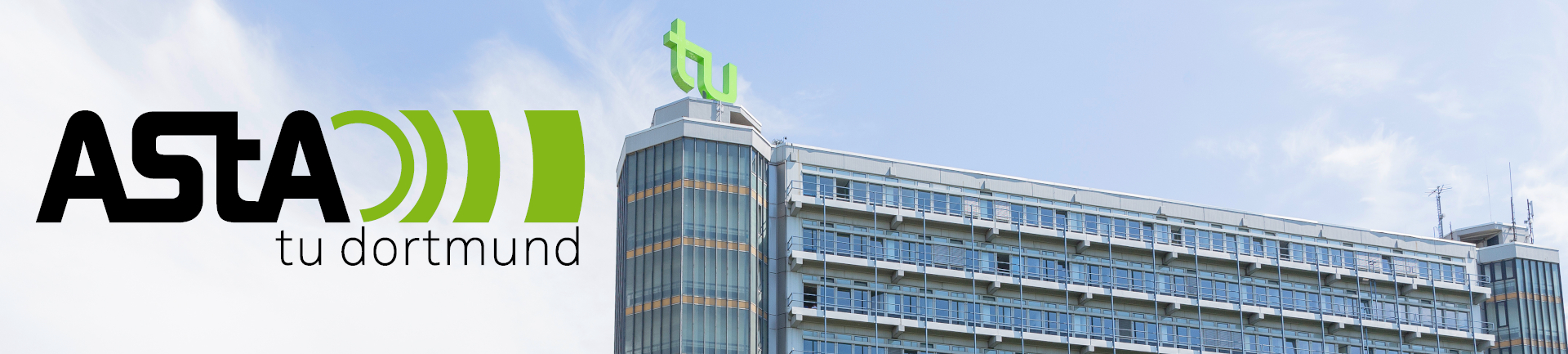
Follow us on Instagram or our WhatsApp channel for all the important updates. We’ve also prepared two Reels there to explain the elections once again.

Student Election

In the student body election, representatives for the Student Parliament (StuPa) are elected. Various “Listen” (candidate lists) run in the election; these are groups of students who pursue common university-political interests. Their election platforms are published beforehand in an election magazine.

International students can also elect representatives for the Autonomous Foreigner’s Department (AAR), who are also introduced in the election magazine.

How to StuPa Election

You vote directly for a member from a list. Often, the individual members introduce themselves in the election magazine. The seats in the StuPa are allocated to the lists based on the total number of votes received. These seats are then distributed within each list according to the number of votes cast for the individual candidates. People who do not receive any votes will not enter the StuPa.

University Elections

In the university election, you can vote for student representatives for the Senate and for the Department Councils. Selected list members also run for the Senate election. In the faculty elections, it is usually representatives from the respective Departmental Student Council (FsR) who stand for election.

Go directly to the elections: university elections

Here you’ll find the election magazine of the election committee: election magazine

Raving against Neonazis

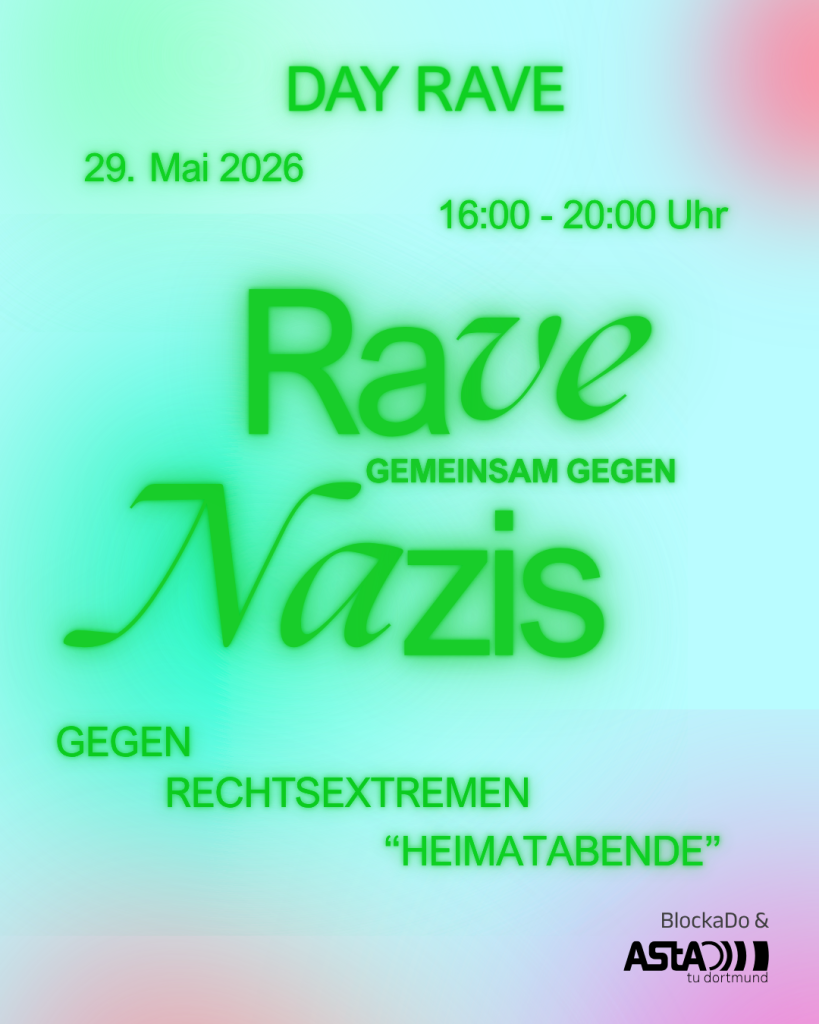
Raving against the far right! ✊ Together with the alliance BlockaDo, we are protesting against the monthly “Heimatabende” organized by the neo-Nazi scene in Dorstfeld — with music, dancing, and good vibes.

For some time now, regular meetings of far-right groups have been taking place again in Dorstfeld. Among other things, these events aim to recruit new supporters and spread far-right ideology. Together with the activists from BlockaDo, we want to take a stand against this and are organizing a day rave at Wilhelmsplatz in Dortmund-Dorstfeld.

🎶Line-up:
Delle
Vicileaks
Lilunja
Nachtaktiv

📍 Wilhelmsplatz, Dortmund-Dorstfeld
📅 May 29, 2026
🕓 4:00–9:00 p.m.

Join us in celebrating democracy and diversity — and in standing up against far-right extremism! 🌈💜

HOPO NEWS May 2026 (UPDATE)

The new edition of the HOPO NEWS (May 2026) has arrived, providing key updates regarding the TU Dortmund campus and our work as the AStA. Here is what to expect:

Statement on the Situation in German Studies: Our official statement, the feedback received and the measures planned by the Rectorate.

BlockaDo – Together Against the Right: Learn what BlockaDo is and discover the protest action we have planned!

Committee Election at TU Dortmund: Everything you need to know for the upcoming committee election.

And more: All upcoming events in May and a short report of our work.

Stay informed and join our WhatsApp Chanel or follow us on Instagram.

On the Situation of German Studies Programs

April 20, 2026

As the General Students’ Committee (AStA) of TU Dortmund University, we feel a responsibility to honestly inform prospective students about current study conditions. Against this background, we can currently only offer a limited recommendation for studying German Studies at our university.

This assessment is not based on isolated experiences, but on persistent issues within everyday academic life. These primarily include insufficient funding, organizational difficulties, and overall strained working conditions within the department. Ultimately, these factors have a significant impact on the quality of teaching and learning.

Concrete Effects on Studies

For students, the situation is primarily evident in a lack of predictability. The department is often unable to provide a sufficient range of courses. As a result, students are sometimes unable to attend mandatory classes for several semesters. Significant problems also arise in the coordination of exams, meaning that requested dates and slots often cannot be made available.

The consequence: degree completions are delayed. This is not due to poor planning by students, but simply because the necessary courses are unavailable. This structural extension of the study period represents a significant burden for many.

Academic support is also under strain. Reliable contact persons, clear structures, and sound academic guidance are currently not always guaranteed, even though these elements are essential for effective academic progress.

Communication as a Central Problem

An essential factor is the lack of communication. Within the individual chairs, there are recurring issues with unclear responsibilities and a lack of coordination. At the same time, information often reaches students and us, as student representatives, late, incomplete, or not at all.

Feedback is often not forthcoming, and processes are unnecessarily drawn out. This further exacerbates existing problems, even in cases where solutions would actually be feasible.

Structural Background

The current situation is no coincidence; it is a manifestation of fundamental structural problems. For some time now, there has been a lack of sufficient resources to ensure stable and comprehensive course offerings. At the same time, necessary changes are being implemented very hesitantly.

In this context, we also view the role of the Dean’s Office critically. From our perspective, there has been a lack of clear measures and sufficient support to noticeably improve the situation. The Rectorate has recognized these structural issues and promises intervention. Consequently, the Rectorate is taking over the coordination of studies and examinations.

Our Commitment – and Its Limits

Over the past seven months, we have made intensive efforts to develop solutions together with all stakeholders. This included numerous discussions, supporting ongoing processes, and putting forward proposals to ease the situation. Despite these efforts, we must conclude that little has changed regarding the fundamental problems so far.

Our Assessment

Successful studies require a reliable framework and a degree of predictability. In our view, neither is currently sufficiently provided within German Studies at TU Dortmund University. We therefore welcome the intervention of the Rectorate. At the same time, the situation remains dynamic, meaning we cannot adequately assess to what extent the feasibility of the program can be guaranteed.

Furthermore, we believe it is important to be transparent with prospective students and, at this time, can only offer a limited recommendation for starting this degree. We continue to work toward improving these conditions, with the goal of being able to issue an unqualified recommendation again in the future.

Advertisement of a Vacancy: Referent for Sustainability and Mobility

We are looking for: Referent for Sustainability and Mobility

Fancy voluntary work in student politics? We’re looking for you!

Your tasks:

  • Representing students’ interests inside and outside the university
  • Planning and running sustainability projects at our university
  • Advocating for a sustainable university and student body

You should bring:

  • Basic knowledge of the student body
  • Interest in sustainability and mobility
  • Interest in political work

AStA officers are elected by the Student Parliament and receive an expense allowance. The workload is about 10 hours per week.

If you’re interested, please send a short application to vorsitz@asta.tu-dortmund.de

We look forward to your application.

1 2