Author: denise.bruessermann
Popular Feminism – A Presentation with Dr. Heike Steinhoff
On the Situation of German Studies Programs
April 20, 2026
As the General Students’ Committee (AStA) of TU Dortmund University, we feel a responsibility to honestly inform prospective students about current study conditions. Against this background, we can currently only offer a limited recommendation for studying German Studies at our university.
This assessment is not based on isolated experiences, but on persistent issues within everyday academic life. These primarily include insufficient funding, organizational difficulties, and overall strained working conditions within the department. Ultimately, these factors have a significant impact on the quality of teaching and learning.
Concrete Effects on Studies
For students, the situation is primarily evident in a lack of predictability. The department is often unable to provide a sufficient range of courses. As a result, students are sometimes unable to attend mandatory classes for several semesters. Significant problems also arise in the coordination of exams, meaning that requested dates and slots often cannot be made available.
The consequence: degree completions are delayed. This is not due to poor planning by students, but simply because the necessary courses are unavailable. This structural extension of the study period represents a significant burden for many.
Academic support is also under strain. Reliable contact persons, clear structures, and sound academic guidance are currently not always guaranteed, even though these elements are essential for effective academic progress.
Communication as a Central Problem
An essential factor is the lack of communication. Within the individual chairs, there are recurring issues with unclear responsibilities and a lack of coordination. At the same time, information often reaches students and us, as student representatives, late, incomplete, or not at all.
Feedback is often not forthcoming, and processes are unnecessarily drawn out. This further exacerbates existing problems, even in cases where solutions would actually be feasible.
Structural Background
The current situation is no coincidence; it is a manifestation of fundamental structural problems. For some time now, there has been a lack of sufficient resources to ensure stable and comprehensive course offerings. At the same time, necessary changes are being implemented very hesitantly.
In this context, we also view the role of the Dean’s Office critically. From our perspective, there has been a lack of clear measures and sufficient support to noticeably improve the situation. The Rectorate has recognized these structural issues and promises intervention. Consequently, the Rectorate is taking over the coordination of studies and examinations.
Our Commitment – and Its Limits
Over the past seven months, we have made intensive efforts to develop solutions together with all stakeholders. This included numerous discussions, supporting ongoing processes, and putting forward proposals to ease the situation. Despite these efforts, we must conclude that little has changed regarding the fundamental problems so far.
Our Assessment
Successful studies require a reliable framework and a degree of predictability. In our view, neither is currently sufficiently provided within German Studies at TU Dortmund University. We therefore welcome the intervention of the Rectorate. At the same time, the situation remains dynamic, meaning we cannot adequately assess to what extent the feasibility of the program can be guaranteed.
Furthermore, we believe it is important to be transparent with prospective students and, at this time, can only offer a limited recommendation for starting this degree. We continue to work toward improving these conditions, with the goal of being able to issue an unqualified recommendation again in the future.
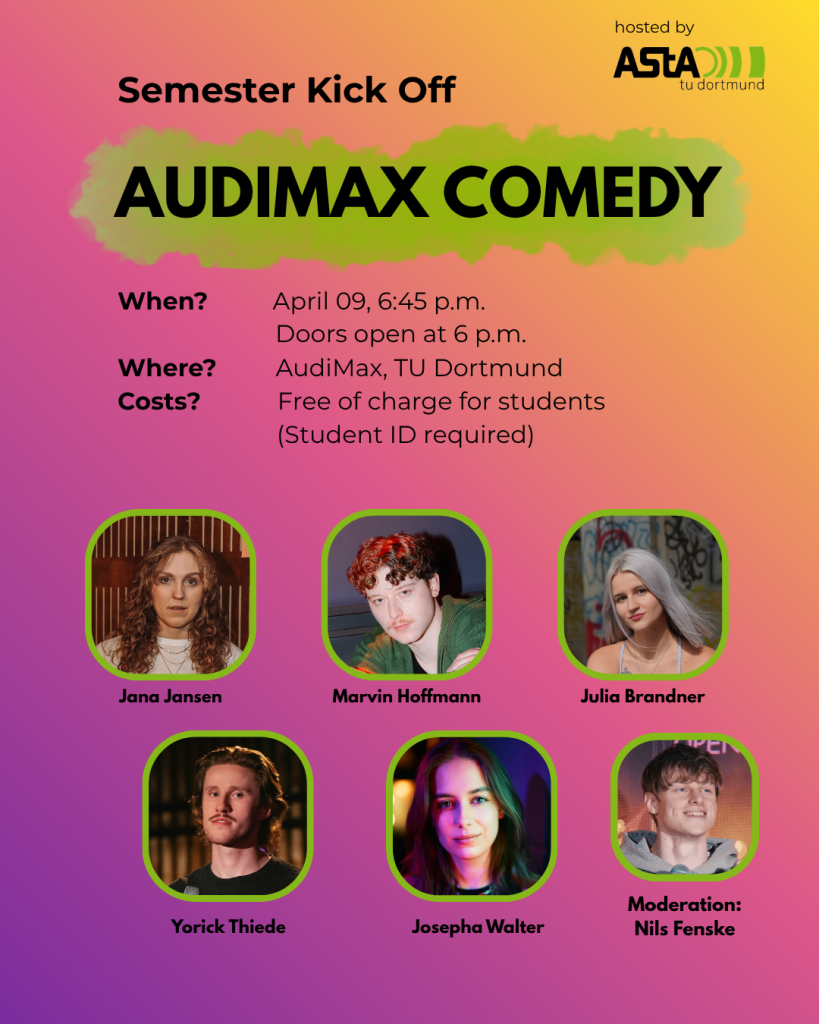
Comedy Night in the AudiMax

When? April 9, 2026, starting at 6:45 p.m. (doors open at 6:00 p.m.)
Where? AudiMax, TU Dortmund
Look forward to a comedy evening at the AudiMax with many well-known comedians: Jana Jansen, Marvin Hoffmann, Julia Brandner, Yorick Theide, and Josepha Walter. The evening will be hosted by Nils Fenske. Admission is free for students. Drinks will be available for purchase.
Hopo News April 2026 – News from University Politics
Cargo Bike (LAStA)
Student groups (departmental student councils, clubs, autonomous committees, etc.) can rent an electric cargo bike from us. To do so, book the LAStA in the reservation system: here.
Once your reservation has been confirmed, you can pick up the LAStA during our business hours.
Before you can really get started, you must complete a test ride on campus for your own safety.
No rentals to private individuals!
Any damage must be reported to the AStA immediately!

HOPO NEWS (Univeristy Political NEWs) March 2026
HOPO NEWS Febuary 2026
Starting in February 2026, we will launch a new edition of HOPO NEWS, in which we will report on current topics in higher education policy. A new issue will be published on the first Monday of every month, and in future, HOPO NEWS will also be available to subscribe to via a newsletter.
Advertisement of a Vacancy: Referent for Sustainability and Mobility
We are looking for: Referent for Sustainability and Mobility
Fancy voluntary work in student politics? We’re looking for you!
Your tasks:
- Representing students’ interests inside and outside the university
- Planning and running sustainability projects at our university
- Advocating for a sustainable university and student body
You should bring:
- Basic knowledge of the student body
- Interest in sustainability and mobility
- Interest in political work
AStA officers are elected by the Student Parliament and receive an expense allowance. The workload is about 10 hours per week.
If you’re interested, please send a short application to vorsitz@asta.tu-dortmund.de
We look forward to your application.
Advertisement of a Vacancy: Social Consultant
A social consultant is being sought
The General Students’ Committee (AStA) of TU Dortmund is offering a permanent position as a social advisor starting on 01/03/2026.
The social advisory service essentially includes the following tasks:
Consultations in the areas of
- study financing and organization
- social benefits
- student employment
- Creation, updating and ordering of relevant informational materials
- Communication with university counselling institutions or other authorities
- Independent promotion of the social advisory service
Desirable qualifications:
- willingness to engage with students’ problems
- ability to work independently
- experience in counselling activities (not required)
- knowledge of social and labour law for students (not required)
Average weekly working time is 6 hours. This is usually divided into 4 hours of fixed consultation time per week and 2 hours for preparation and follow-up. Remuneration follows the TV-L pay scale (approx. €15.85 per hour).
Applications should include a short statement about you and your qualifications, and a CV. Application documents must be received by the AStA no later than 16/02/2026.
People with disabilities, people of colour or people with a migration background will be given preferential consideration in hiring if equally suitable in personal and professional qualifications. Women will be given preference in accordance with the North Rhine-Westphalia Equal Opportunities Act where qualifications are equal.
Send your application to:
AStA TU Dortmund, Emil-Figge-Str. 50, 44227 Dortmund
or by email to: lmauve@asta.tu-dortmund.de